
21
Feb
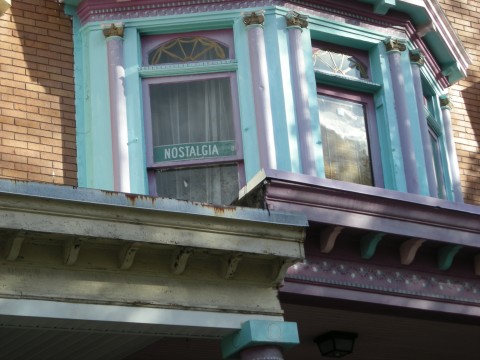
Window, Row House 2100 block Calvert St., Baltimore, MD
“From the Greek nostos, to return home and the Old English genesan, to survive,” the word nostalgia also denotes a “wistful or excessively sentimental yearning for return to or of some past period or irrecoverable condition.” Pilgrimage refers to “the journey of a pilgrim or wayfarer especially to a shrine or sacred place and the course of life on earth.” [Merriam-Webster’s Collegiate Dictionary, 11th edition].
Before returning from Washington, DC, to Washington State, Seelye and I retraced the neighborhood haunts of our courtship and first married life in Baltimore, MD. As now, we lived then on a threshold between university life and science, family and faith. Despite cloudy windy cold weather that warmed with the day, the Sunday morning drive sped us first to the Baltimore Episcopal Cathedral of the Incarnation, the seat of Maryland’s fourteenth bishop, Rt. Reverend Eugene Taylor Sutton. As canon, Eugene had signed me up as a volunteer in the National Cathedral Center for Prayer and Pilgrimage, November 28, 2006. On June 28, 20008 the National Cathedral filled with witnesses to the joyous consecration of this prayerful, bold-hearted bishop. As Bishop Claggett, Maryland’s first and first to be consecrated on American soil, was a slaveholder, Bishop Sutton’s call, with the election of the forty-fourth President of the United States, heralds a deep healing in our country.
Lacking a transept or crossing, the small, narrow Gothic Cathedral of the Incarnation teems with children and manifests careful loving intense use. To the right of the entrance the poignant chapel to Children of the Light, names the murdered youths of the city, thirty-five to that date. Two more the next week. A banner bearing bells and a satin ribbon for each teen or child drapes over the stair rail leading down to the Peace Chapel, Columbarium, and undercroft. There the dark wood floor is newly painted with a beautiful blue labyrinth. Everywhere the eye sees pictures, icons, windows, sensing the spirit of mindful, whole-hearted occupancy, and history.
Next we approached Johns Hopkins University, retracing Seelye’s old running route along San Martin Drive. Everywhere new buildings! Finding a parking spot near new Decker Court, a map pointed us to Latrobe Hall. The familiar end doorway allowed a glimpse of the same hallway leading in the past to the Hydraulics Laboratory. There Seelye had built wave tanks, paddles, stratified water with 100-pound bags of salt and prepared his thesis. Satisfied about the science, we could not find our way to St. Paul Street.
Few people braved the cold wind, but an angel appeared: a Nigerian-born security officer guided us through the 1963 familiar walkway, past the Merrick Barn theater to the entrance at 33rd Street. Two blocks east and turning south, there was our same rear porch with the trash chute, the courtyard with the lion head fixed to a new longer, wider green-painted wall, and a new wooden gazebo visible to the rear. Today the entry sports a handsome black iron grill gateway; flower pots fill the right side. The entry doors are painted red! Maroon awnings over each side of the gate and a big sign all announce St. Paul Court Apartments. The old A&P across the street is now an attractive independent Eddie’s Market. Next we strolled around the block along Calvert Street, noting that the alley where we rented our garage for $10 a month, is new built, but plenty of similar ones survive. Along Calvert Street I noted and photographed the sign depicted above: Nostalgia.
Returning along 31st Street to St. Paul we happened into Donna’s Restaurant on the corner for a tasty colorful lunch in a warm place. Waitress Julia arrived only two months ago, but enjoyed our story and attended us cheerfully. An intense happiness infused my partaking of the meal with Seelye. Communion. We walked past Seelye’s bachelor apartment, a studio with bay window on the ground floor of number 2125 St. Paul Street, around the block of gorgeous stone buildings and across St. Charles St. to the Baltimore Museum of Art.
A student of my father’s from California days, then a crystallographer at JHU, had given us membership as a wedding present. How we enjoyed trips there and renting pictures from the rental gallery. Now the City of Baltimore subsidizes BAM and the Walters Art Gallery so admission is free! To browse the uncrowded galleries ’twas very heaven.” The European paintings (remembered as inferior to the Boston Museum collections) sparkled, the British landscape drawings and watercolors lured, the Cone collection, remodeled in 2001, simply shone. Two independently wealthy sisters who mostly purchased directly from the artists and their travels, formed the single largest collection of Matisse works. Benefactor Joseph Epstein’s collection of European paintings struck me as choice. And, since our time, a trustee has donated eight exquisite miniature rooms. The New England sea captain’s salon has a tiny telescope a little rounder than a toothpick, pointed out the window. Squinting, you can see light through it! The one room of Chinese art is spaciously and informatively arrayed. Small, but distilled pleasure.
Such a car ride offers time for a particular intimacy: one does not look the other in the eye. The freedom from interruption fosters rumination and sharing thoughts.
“We may not have as much money for retirement as I hoped,” Seelye observed.
“Yes, my nest egg has dropped by a third. I have been thinking and praying about getting older. We have been blessed by wonderful experiences and travel in life. Three things money cannot buy: time, health, and friendships.”
Which brings me to fibrinogen. Created in the liver, the plasma protein circulates in the blood. When clotting is needed, with the catalytic action of the enzyme thrombin, fibrinogen forms the insoluble fibrous protein fibrin, forming clots. The molecule fibrinogen has served me faithfully as metaphor for friendship, especially created in response to life’s inevitable losses. As we prepared to marry, my mother died, and Seelye found our first apartment, applying in choosing his love for tall ceilings, windows for light and air, wood floors, workable kitchens and inviting bathrooms. Mourning my mother, that first summer in Baltimore, until we furnished the spare apartment, I suffered shin splints. I taught myself to plan, shop, and cook delicious and nutritious meals. Where my mother knew Prometheus, I invoked Hestia.
My father used to call me his little duck. In the 1980s I found in San Francisco’s Chinatown, a carved Chinese miniature ivory “looking-back” duck. Later, dropped from the mantel, the duck lost its head. Looking back is salutary on occasion, but not a way to live. “Seelye,” I said in the car driving home, “we could not know our journey from 1965 to today. No more can we tell what lies ahead. Beyond money, we can take care of our bodies, our minds, our spirits. As Palestine Patriarch Miles Sherrill used to intone, ‘Grow old along with me, the best is yet to be’.”
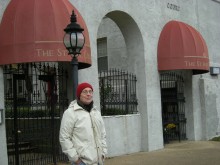
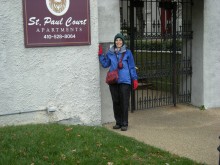
Seelye and Julie, 3120 St. Paul Street, Baltimore, MD. November 16, 2009
03
Dec
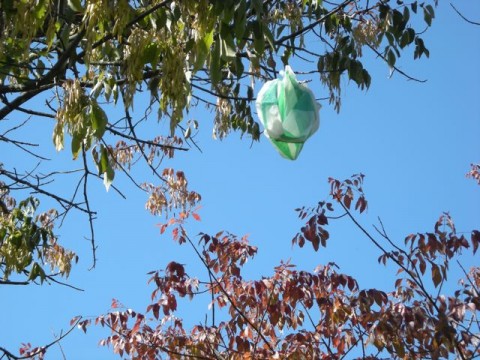
Culps Hill, Gettysburg, PA. Neither did the bag witness the battle, nor the combatants know plastic.
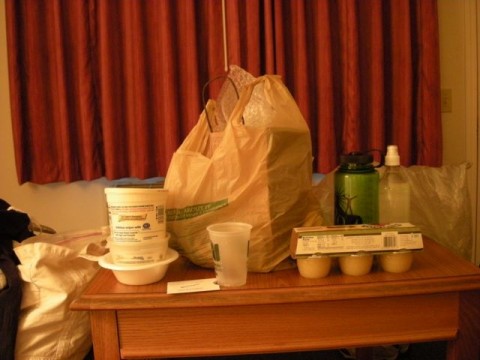
Motel, Baker City, OR. The accumulation of plastic from 6 days on the road, DC to Seattle 10/08
It’s the numbers, expanding large and small: giga- to tera-, nano- to peta- scale. Physicist Hans Bethe explained that shopping between the world wars in Germany taught him the value of big numbers. He would bicycle to the shops for the items his family needed. Gradually, steadily it took the capacity of his handlebar-mounted basket to carry the stack of inflating Deutsches Marks to pay the merchants. Orders of magnitude, times ten.
According to the website http://www.reusablebags.com, “Well over a billion single-use plastic bags are given out for free each day.” They form an incoming stream to my household in the form of grocery and farm market goods, dry cleaning and laundry bags, shipping bags for clothing and medications, book and miscellaneous purchase-carriers from garment bag-size, to bubble wrap-liners and Styrofoam chips or peanuts. Then, too, the difficult-to-substitute containers for yoghurt, and drinks, the quart and half-gallon boxes and jugs all labeled #5 or #6, are not currently recyclable, and so expand the trash.
Down the chute, but not out of mind. Truthfully, it is my mind, my serenity that feels threatened.
With the inevitable rise in petroleum prices due to production reaching the long-heralded and long-denied peak oil, and for living in a fifth-floor small apartment in the Capitol City, I have begun to question how to reduce this tide of incoming one-use plastic? How to educate myself and others to analyze the true, lifetime costs of production, product, and disposal. Plastics are eternal.
In The Upside of Down(2006), Canadian scholar Thomas Homer-Dixon helpfully defines the energy return on investment, EROI. The rise and decline of a civilization or nation state correlates with the ease of marshalling energy. For the Roman coliseum and the aqueducts, engineers mobilized a well-fed labor force to build ingeniously designed and precisely crafted arches, stones, tiles and bricks. The agrarian economy produced the high quality calories, food for laborers and animals to build and maintain such works. However, “locked into a food-based energy system, as the Roman empire, expanded and matured; as it exploited, and in some cases exhausted, the Mediterranean region’s best cropland and then moved on to cultivate poorer lands; and as its grain supplies snaked farther and farther from its major cities, it had to work harder and harder to produce each additional ton of grain.” (P. 55)
In our time, petroleum yields three great essential energies: chemicals including fertilizers, plastics, and fuel. Farmers choose to use manure-based fertilizers with some dangers of pathogens persisting, and still requiring fuel to heat, transport and distribute, or chemical fertilizers. Farmer Eddy Rankin of Twin Springs Fruit Farm, Orrtanna, PA, reports that last year he paid less than $360 per ton of 19-19-19 (NPK) fertilizer. Now it tops $1000, a three-fold increase. To protect soil fertility and crop yields, he and his partners continue to apply the preferred fertilizer, and only modestly raise prices at the stand. Does this price increase herald a change for energy return on investment, EROI?
At the time of sale, producers of the corn crop face three choices: feed people, feed livestock, or feed fuel tanks. Purchasers compete. Heifer International reported in 2008 that the proportion of annual greenhouse gases in the United States is 18% from producing livestock for meat compared to 13% for all forms of transportation. These choices explain why food costs have risen, will continue to rise, and illumine the widening gap between rich and poor, well nourished and starving. Again, the numbers are staggering and hard to comprehend. Furthermore, the income gap between billionaires and poor people is so great that compounding increases will fail to reduce the gulf for generations to come (Homer-Dixon, 2006).
At the Republican Convention the cheer, “drill, baby, drill” roiled the crowd, hot to open the last great North American wilderness in Alaska to resource exploitation. Too many Americans do not yet grasp the idea of energy return on investment. Furthermore, Elizabeth Kolbert quotes “The Department of Energy estimates that there are eighteen billion barrels of technically recoverable oil in offshore areas of the continental United States that are now closed to drilling. This sounds ample, until you consider that oil is traded globally and that, at current rates of consumption, eighteen billion barrels would satisfy less than seven months of global demand. A DOE report issued last year predicted that it would take two decades for drilling in restricted areas to have a noticeable effect on domestic production, and that, even then, ‘because oil prices are determined on the international market,’ the impact on fuel costs would be ‘insignificant’.” (The New Yorker, Aug. 11 & 18, 2008).
Who will ask, “Is it worth it?” What about species loss as the Arctic Ocean shrinks and habitats change? What about rising sea levels? Since Hurricanes Katrina and Rita, we are slightly more sensitive to the power of nature, and newly appreciative of wetlands. Still, half the United States’ supply of oil passes through the ports of Louisiana (NPR, All Things Considered, 5 September 2008). Can we afford to abandon the drilling platforms, refineries, and transfer points of the Gulf of Mexico to exploit and maybe exhaust the Alaskan coasts?
Living in Washington DC, I have searched for food sources like Puget Consumers Cooperative in Seattle for local, organic foods. I carry a handy nylon bag and extra clean plastic “T-shirt” bags while shopping. I wash, dry, and reuse every possible plastic bag. Following the example of my daughter and my website designer, I carry a sealable plastic 12-ounce thermal cup, especially on airplanes. We avoid restaurants serving on Styrofoam and plastic. Remembering the one billion plastic bags handed out free worldwide per day, I talk with merchants as I unfold my recycled bags.
Nonetheless, the waste stream appalls. Because the air pollution controls are looser than in the United States, some “recycled” items go to Asian countries where they are burned. We eat meat as a condiment and pay attention to the source and species of our seafood. We combine trips and limit our use of the car. People can sign up for Terrapass and purchase carbon credits for travel expenditures.
“Little drops of water, tiny grains of sand, make the mighty ocean and the spacious land”goes the song learned in first grade… the numbers… the math. Plastics are eternal. We Homo sapiens are mobile bags of water with about 15% other chemicals, that somehow embody a mind, a spirit. Can we govern ourselves, reign in our desires, understand and meet these sweeping changes? Can we imagine life as other living beings live, whales and elephants, tuna and turtles, bacteria and in-between viruses? And live as though the future matters? I hope so, I pray so, I write so.
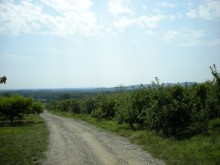
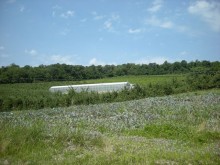
L. View of Little Round Top, Gettysburg, from Twin Springs Fruit Farm, Orrtanna, PA
R. Greenhouse, opposite direction
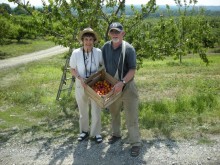
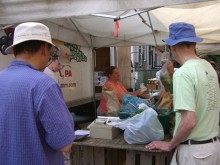
L. Julie and Eddy Rankin with fresh-picked apricots, July 4, 2008
R. Shogo Hayashi and Seelye buying from Martha at the TSFF Saturday Market
All Souls Memorial Episcopal Church, Washington DC
29
Aug
The week I arrived at college I purchased my trusty steed, a classic Raleigh three-speed bicycle. Augmenting the bright reflectors fore, aft, and sideways, a generator applied to the rear wheel powered the bold headlamp. A sturdy rear rack supported the book- or grocery-filled saddlebags. A tuneful bell announced my progress. Versatile, practical, and a good fit, the bicycle served me well.
Seelye’s parents gave us a rounded black dowager Peugeot 403 sedan for a wedding present. I was hit from behind in the Arboretum, a blow that creased the roof, flattened the front right tire on the stone curb, and crumpled the trunk. Though the steak and clean laundry within survived intact, I replaced the totaled car with a larger white Peugeot 504 sedan. I thought of the car as Snowy, after Tintin”s dog, Milou, translated into English. While sporty to drive, the model year 1973 proved to be an idiosyncratic mixture of parts and the car difficult to maintain. For example, when they failed the armature, motor, and electrical parts for the vital windshield wipers came from three different manufacturers in France and Germany. Luckily I found a great mechanic and learned to listen to him with the attention I soon paid to our pediatrician.
With the advent of children I remembered my ancestor of Coryell’s Ferry, New Jersey, across the Delaware River from New Hope, Pennsylvania. He ferried folk, goods, and General George Washington, who gave him his fishhook collection in gratitude. It is no longer on the map or GPS because after the Civil War, a senator Lambert changed the name to his, Lambertville. By 1986, however, the Peugeot (Puget) ceased to be reliable for carpooling elementary and preschool classmates of Carl and Maria. While it sat at the shop during Thanksgiving awaiting a new radiator, after Carl and Maria snacked on popping candies that drifted below the seats on a summer road trip to eastern Washington and Mt. Rainier, a rat ate a hole in the upholstery. Even mended, ever after Maria refused to sit on that side of the backseat, even in the next car!
Methodically, even overbearingly, I set about researching a replacement with a view to mechanics, economics, and feel. During the same week I test drove the Volvo 245 station wagon with the option of a third seat for two children up to 100 pounds, a woman driver of the 244 sedan turned a corner in downtown Seattle, beside a flat-bed truck carrying cement panels for a skyscraper facade. As they turned in tandem, some panels slid off the top of the load onto the roof of her Volvo, flattening the top of the car. The roof lowered slowly enough and only far enough to permit the driver to crouch in the leg well and stretch over the gearshift onto both seats. While it took a couple of hours to extricate her, she emerged uninjured. Of the strength of the steel-protected passenger cabin this was powerful evidence, enough to overcome the contrived advertisement Volvo later withdrew that depicted a Volvo sedan holding up a small truck on its roof.
So with Seelye’s help, I traded in the Peugeot and purchased the Volvo 245 outright at the equivalent cost then of one full year of college, room, board, and tuition. Not luxurious, but practical: with automatic transmission, wheel hubs for snow tires, a locking gas cap, and third seat folded under the cargo bed in the rear. My father used to say to me, “Have a little faith, Julie.” I chose his and my favorite yellow flax color and thereafter drove the slightly underpowered “stately tank” with pleasure and confidence. No buyer’s remorse at the expenditure, which exceeded the down payment on our house. The next largest check we wrote when Carl himself went to college. A work horse, a Percheron, of a car.
Now my Volvo is the age of majority. I am reminded of my high school foursome date with Rick Saulnier to hear Joan Baez sing in Kenmore Square, Boston. He drove into our driveway in Lexington, courteously greeted my parents, and seated me in the middle of the front seat for the drive to Brookline for the other girl. As I complimented him on his cared-for chariot, he said, “I call her Shasta.”
“For the mountain or the daisy?”
“Neither, she’asta have new shocks, new tires… always something.”
The car, like faith, needs renewal. What is the responsible ecological and economical course? How to evaluate the true costs? At the time of purchase, Beth in the dealer’s service department (a pioneer to have a woman in that responsible position then) educated me that to buy the car in replacement parts would cost 10% more than the purchase price. With time, parts would be harder to find. And who could predict the currency exchange values for a foreign product? Should I fix it, sell it, donate it? Prudent use of a car is still necessary in hilly Seattle.
Buddhists vow: “I believe in Buddha, I believe in Sangha, the community, and I believe in Dharma, truth. Dharma gates are numberless, I vow to enter them all.” Thus what to do with my car is a gateway to new thinking in the era of climate change, and a metaphor for my own aging. “She’asta.” Mountain, flower, deed.
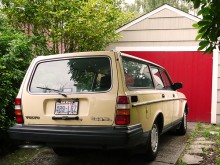
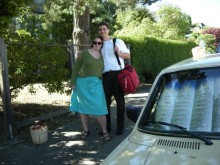
Julie Coryell”s Ferry. L. by Maria C-M, 8/08. R. 20 July 2008. Just married in the Seattle homestead garden! Sarah Irene Starkweather and Carl William Coryell-Martin on way to Kenmore Air seaplane (watermer) ride to their honeymoon in Victoria, B.C.
12
Aug
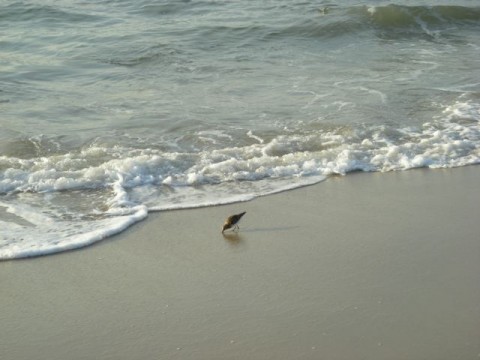
Sandpiper at surf”s edge, Assateague, VA, May 2008
During our newlywed days in Baltimore, Seelye began his dissertation. Early mornings he walked to his lab, returning about 5 pm for a 45-minute run, bath, and dinner. Usually he spent two more hours after dinner in the lab.
I mourned my mother, wrote thank you notes for lovely wedding gifts that manifest to this day the love held for both our families and friends. I read cookbooks and searched Baltimore markets for fresh and new ingredients, learning scientifically to plan, assemble, and produce nutritious and multi-ethnic meals.
Of his mother Lucy’s cooking Seelye claimed that college food was better, but she had discovered Adele Davis and bequeathed to us blended smoothies, use of whole grains, and son Carl’s favorite carrot cake, the cream cheese icing decorated with healthy currants and candy red hots. While Seelye delighted in my mother Grace Mary’s meals, her advancing alcoholism rendered consistent teaching and reliability dicey. I did make sure to learn her vinaigrette, stove-top souffled omelets, and the festive Seeley family rolled stuffed crepe recipe called “Germans”. During my high school years, the Bulgarian-born neighbor, Jeannie Robell had schooled me to eastern European delights, Russian borscht, baklava, chicken and leek pies, bureki, even the process of presenting a sheep’s head!
To compose his title and opening sentence, pad in hand, Seelye stretched out on our sofa and I on the polished wooden floor of our sunny walk-up apartment, head to toe so we could talk. He intoned variations on “The Slow Motion of a Finite Flat Plate Towed Through a Viscous Stratified Fluid,” convulsing us in giggles. The word flat cried out for a companion silent e. Not intuitive with the physics, repetition imprinted the words. I grasped the metaphor of the forward and rearward wakes generated in the wave tank of salt-layered water of graduated densities. How to cut in life a forward wake of appropriate energy, confidence, buoyancy, neither too weak, nor too strong?
In 2008 we visited Gettysburg, PA, during the 145th anniversary of the battle, July 1-4. Narrated by Morgan Freeman, the explanatory film in the brand-new Visitors Center raises three questions: 1. What is the meaning of the union? 2. How to end slavery? 3. What is the meaning of citizenship? Accompanying the narration, the historic pictures of African Americans as slaves, free persons, and soldiers enlivened the Civil War more than I had ever experienced. That the narrator emphasized also that the third question is still most active today resonated with Sarah Starkweather’s doctoral thesis on issues of citizenship for expatriate Americans, their children, power to vote, and secure Congressional representation. Sarah and our son Carl married in Seattle on July 20th.
Although the scenery of Gettysburg is pastoral and beautiful, the bloodshed was horrific and sadness pervades the memorial stones. Cubic markers at ankle height along both lines record L.F. and R. F. for left flank and right flank, indicating just how densely packed the combatants stood, how vulnerable the men, horses, trees and plants were to the intense fire. Philadelphians, 80 miles away, heard the bombardments.
Today, those three same questions loom in our public and private lives: How to create and preserve union, how to end slavery, gender/racial stereotypes, and what does citizenship mean? What are our wakes, fore and aft? How to be a wake, be awake?
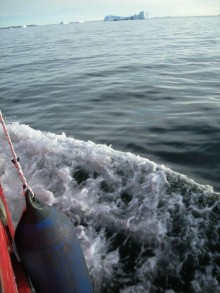
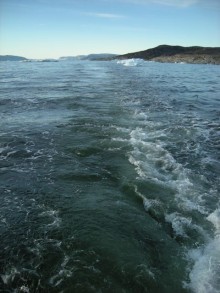
Sailing to and away from Rodebay/Oqaatsut, Greenland, 17 August 2008
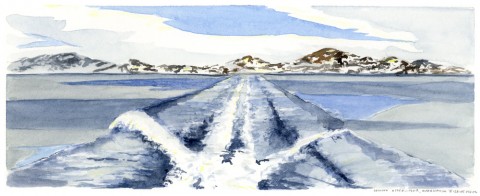
Leaving Upernavik, Greenland, watercolor by Maria Coryell-Martin, 2005
17
Jun
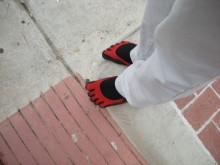

Carl”s Vibram Five Fingers, Boat-tailed Grackle in Grapevine, Texas
First, we all occupy our bodies. Over a lifetime, that embodiment can be uneasy as our bodies grow and change on a timetable of their own. Nor have we yet decided on the place of consciousness, awareness, thinking. But the electric connection of synapse can surpass ordinary time, and the effect of forgetting, entering the cloud of unknowing, can prevision the realm of the dead.
In Israel, occupancy declares foremost in the stones, the highways, the crenellations of new settlements, in the watersheds, the rocky wrinkling of the earth’s crust defined as country, place, holy. Occupancy manifests acoustically as well, in the noise of jet planes overhead, in traffic, in unmufflered carts penetrating the winding streets to supply market stalls and construction sites in the Old City, in the sound of water flowing in planned courses and fountains. Sometimes, silent seeping in springs make green brushstrokes on rocky outcrops as at Wadi Kelt near Jericho. There the ancient Byzantine Orthodox Saint George’s monastery clings to the canyon wall as if stuck on by superglue. Within the holiest Christian Church of the Resurrection in Jerusalem, among the eastern denominations who depend on unamplified human voices, their powerful organ declares the occupancy from their portion of the Roman Catholic Church.
Above all in Israel, bristling with guard towers, barbed wire, searchlights the outsize, winding, forbidding separation wall asserts occupancy. Often bracketed by demolished concrete piles, the former homes of people whose occupancy is denied, the fractal boundary of cement, steel, barbed wire, observation posts, imprisons implacably. The wall imprisons both occupiers and occupied.
Thinking about occupancy, where people can settle with legitimacy, stability, and hope presence can develop to residency and citizenship. Describing pathways for embattled peoples to make new lives together, Desmond Tutu has written a book, No Future Without Forgiveness. Further, changes in the cold regions of the world, the dry deserts and wellsprings like the Himalayan plateau where five great rivers of the world begin their journeys through the most populous countries of the planet, now call us to new sensitivity, new courage to forgive, share, cooperate. Might we cultivate new habits of occupancy to promote just, intentional, citizenship in the world?
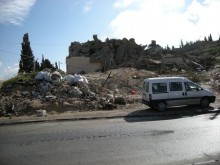
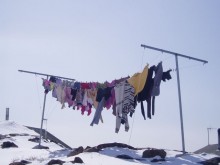
Demolished home, Bethany, February 2008. Greenland laundry, May 2005 (MCM).